Coopers Chase
The Thursday Murder ClubCoopers Chase is a retirement village in the Kentish Weald whose modern life unfolds inside the grounds and altered buildings of a former convent. A place marketed as a luxury retirement community, it is also a landscape layered with older purposes: a hospital, a religious house, a cemetery, and the accumulated lives and secrets of its residents. Its facilities create a busy communal setting, while its grounds become the site of a cemetery dispute and several decisive turns in the investigation.
Setting and origins
Coopers Chase lies beyond Fairhaven, reached from the A21 by a route that passes an old working phone box, a small bridge over the Robertsmere, and a single-track road through hedgerows. The approach is deliberately ungrand: the river is modest, and the bus stop near the entrance serves only one bus in each direction a day. In contrast, the village occupies hilly land among woodland and open countryside in the Kentish Weald.
The development began about ten years before the events of the main story, after the Catholic Church sold the land. Its first residents arrived three years after work began. Coopers Chase was promoted as Britain’s first luxury retirement village, although Ibrahim Arif had checked and found that it was actually the seventh. Around 300 people live there, and residents must be over sixty-five. The steady passage of Waitrose delivery vans, carrying wine and repeat prescriptions over the cattle grid, gives the community’s polished promise a practical, domestic texture.
The site’s earlier history is inseparable from the Sisters of the Holy Church. The convent had stood for more than a century, with dormitories, low communal dining tables, a chapel, and a life organized around religious service. Beside it, Willows began in 1841 as a voluntary hospital for people who were sick or otherwise had nowhere to turn. It later became a care home, but legislation in the 1980s led to its closure. After the last nun died in 2005, the Church sold the convent and associated property together. The village is therefore not simply a new development on empty land: it occupies buildings shaped by service, care, and religious life.
Buildings, facilities, and grounds
The old convent remains the architectural center of Coopers Chase. Three modern residential developments extend outward from it, while the former religious interiors have been adapted for recreation and communal use. Most strikingly, the west-facing side has been replaced by glazing to accommodate the swimming-pool complex. Beyond it lie the bowling green and the visitors’ car park, where parking permits are so limited that the Coopers Chase Parking Committee has unusual influence over village life.
The leisure facilities range from an arthritis therapy pool that is, in practice, a Jacuzzi, to a sauna, gym, and exercise studio. Residents can gather for Zumba in spaces that once held convent beds, or choose quieter activities in the Jigsaw Room. A library and lounge provide for reading, committee meetings, and football on a flat-screen television. The convent refectory’s long, low tables remain, although the room now serves as a contemporary restaurant. These conversions keep traces of the former institution visible even as the village supplies a different kind of shared routine.
The grounds extend across twelve acres of woodland and open hillside. There are two small lakes: one natural and one made by Ian Ventham’s builder, Tony Curran, and his crew. Ducks and geese appear to favor the artificial lake. Sheep graze near the top of the hill, where the woodland opens onto pasture, and a herd of twenty llamas lives by the lake. Ventham initially bought two llamas to make the development look distinctive in sales photographs; the herd grew beyond that original plan. The mix of working land, landscaped amenities, and conspicuous sales touches gives Coopers Chase a rural setting without making it a conventional country estate.
Community and everyday life
Coopers Chase is a residential community as well as a collection of buildings. Its residents organize activities and committees, share common rooms, and depend on one another for practical help. That everyday structure also gives the village its own informal systems of influence. The scarce visitor permits make parking a persistent concern, and the Parking Committee’s authority is treated as a political fact of local life rather than a minor administrative detail.
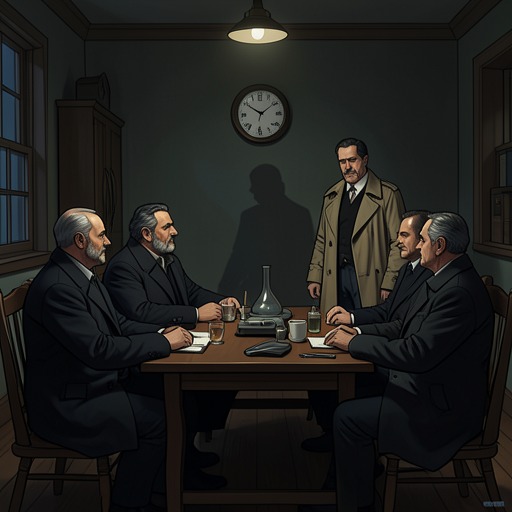
The Jigsaw Room recurs as a meeting place for both recreation and serious discussion. It is where the Thursday Murder Club gathers, and where residents can assemble when events demand a more formal conversation. In one meeting, a dispute in the Cryptic Crossword Club leaves the room unexpectedly available; the Thursday Murder Club occupies its regular seats while Chris Hudson and Donna De Freitas bring chairs from the lounge and question Matthew Mackie. The scene places a major disclosure within the village’s ordinary network of clubs and shared spaces. The same room that accommodates gentle pastimes can become a setting for investigation and testimony.
The village’s geography also shapes residents’ practical decisions. When Elizabeth proposes testing whether Ian Ventham could have travelled from Coopers Chase to Tony Curran’s house in time to kill him, the group sets out in Ron Ritchie’s Daihatsu. Ron is the only one with a car, Joyce has not held a licence for thirty years, and Elizabeth’s claim to a valid tank licence does not settle the argument. Ibrahim Arif drives because he is the only person who understands the satnav. They know Ventham left Coopers Chase at exactly 3 p.m. and that Curran was murdered at 3:32; the journey turns the village’s position in the surrounding landscape into evidence they can test.
The cemetery and the investigation
The Garden of Eternal Rest sits on a hill above the convent, enclosed by iron gates and low stone walls and looking out over the Kentish High Weald. It began as the burial ground associated with the convent, where members of the Sisters of the Holy Church were laid to rest. Its proximity to the modern village makes the cemetery both part of the residents’ surroundings and a contested inheritance from the site’s earlier life.
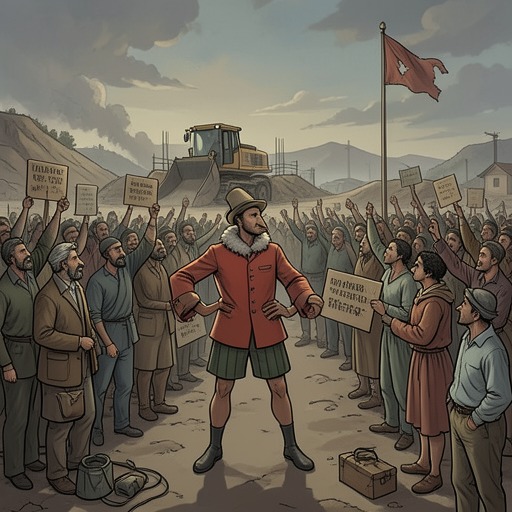
When diggers arrive to work in the cemetery, the village’s close communications defeat the logic of a dawn operation. A first call is recorded at 6:21 a.m.; by 6:45, news has spread across Coopers Chase by landline. An attempted WhatsApp group had not caught on. Residents emerge to discuss what to do, and when Ventham returns at 7:30, he finds the village out. The low-loader continues through the car park toward the cemetery, with Bogdan Jankowski opening the heavy wooden gate so it can proceed along the narrow path. The residents’ response turns a planned excavation into a public confrontation over the grounds and their dead.
The cemetery also becomes a site of police attention. After later discoveries, police vehicles and a white van believed to belong to forensics are parked nearby, and officers in white suits go up the hill with spades. Residents watch for news, including Martin Sedge, who trains binoculars on the site from his top-floor flat in Larkin Court. The cordon and the careful digging make the village’s hidden history visible without immediately resolving it: to people looking on, the activity can still seem like no more than digging.
The investigation reaches back beyond the immediate dispute. At a meeting in the Jigsaw Room, Ibrahim explains that Ian Ventham was probably killed by an injection administered to his upper arm in a crowd; the combined resident lists identify sixty-four people at the scene, alongside the investigating officers and Bogdan. Coopers Chase is thus not merely the backdrop to an isolated crime. Its gathering places, population, routines, and access points determine who could have been present and how the investigators must reconstruct events.
Ownership and narrative significance
After Ventham’s death, residents wonder who will take over Coopers Chase. Gemma Ventham sells Coopers Chase Holdings to Bramley Holdings, but the residents cannot initially discover much about the company, even after seeking help from Joanna and Cornelius. The sale introduces uncertainty about the village’s future without establishing what the new owner will do. Ownership remains a live concern because Coopers Chase is both a home and a development whose land and buildings have been transferred between institutions and commercial interests.
The village’s narrative importance comes from the way these uses overlap. The former convent’s chapel, hospital, cemetery, and communal rooms belong to different periods, but none has become irrelevant: the history of the Sisters remains present in the buildings; the cemetery dispute makes the residents defend a place of burial; and contemporary meeting rooms support the amateur and official investigations. Coopers Chase offers comfort and shared life, yet its daily landscape also contains the material traces of earlier care, unresolved secrets, and contested plans for change.